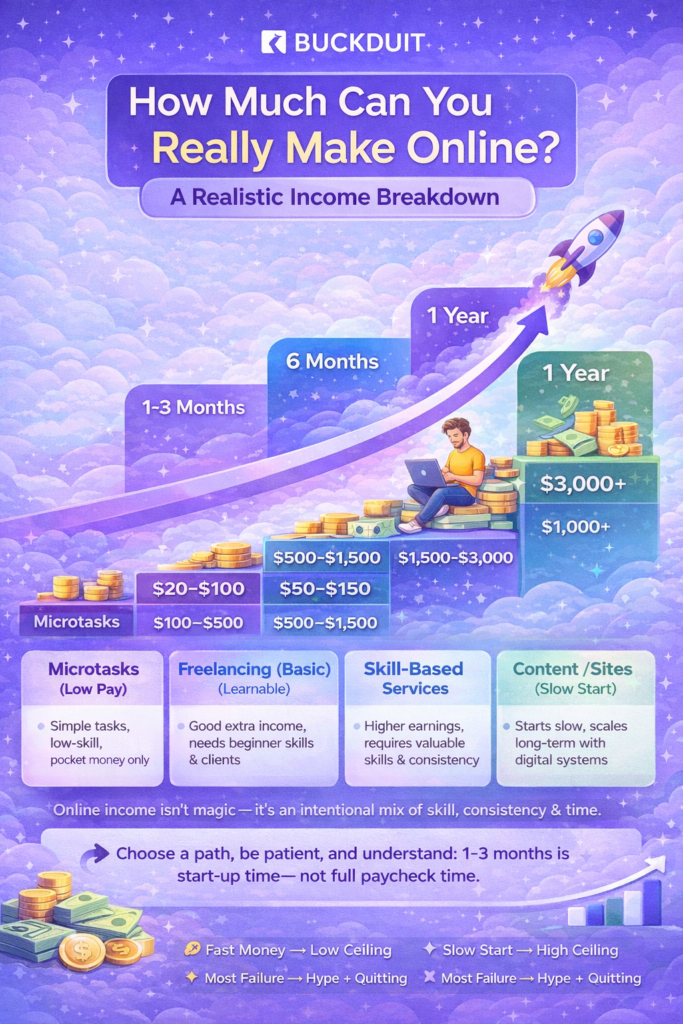
How Much Can You Really Make Online? (A Realistic Income Breakdown)
Making money online is often marketed as fast, easy, and effortless. Scroll through social media and you’ll see screenshots of payouts, “quit my job” stories, and promises that anyone can earn thousands from home with minimal work.
The reality is very different.
Yes—people do make money online. Some make side income. Some build full-time careers. A small percentage earn a lot. But most beginners fail not because online income is fake, but because expectations are wrong.
This article breaks down how much you can realistically make online, based on method, time commitment, skill level, and consistency—without hype, fake screenshots, or exaggerated claims.
The Honest Truth (Before the Numbers)
Online income is not one thing. It spans everything from simple microtasks to high-skill freelancing and scalable digital businesses.
The biggest mistake beginners make is comparing:
- A first-month beginner
with - Someone 3–5 years into a system
That’s like comparing someone who just joined the gym to a professional athlete.
Before looking at income numbers, you need to understand what category you’re entering.
The 4 Main Types of Online Income
1. Task-Based Income (Low Skill, Low Pay)
Examples:
- Microtasks
- Surveys
- Data tagging
- Simple app testing
What it really pays:
- $1–$5 per hour
- Occasional good days: $8–$10/hour
- Monthly (casual): $20–$150
Reality check:
This is not a scam—but it’s not a career. Task-based work trades time for very small money. It works best as:
- Pocket money
- Testing online income basics
- Absolute beginners
If someone promises full-time income from microtasks alone, that’s a red flag.
2. Entry-Level Freelancing (Skill-Light, Learnable)
Examples:
- Simple writing
- Data entry
- Virtual assistance
- Basic design or editing
What it really pays:
- Beginner: $5–$10/hour
- Some experience: $10–$20/hour
- Monthly (part-time): $300–$1,000
Reality check:
This is where online income starts to feel real. However:
- Income is inconsistent at first
- Clients come and go
- Skill improvement matters more than hustle
Freelancing rewards people who treat it like a profession, not a quick win.
3. Skill-Based Online Income (High Leverage)
Examples:
- Copywriting
- Web development
- Marketing
- SEO
- Video editing
What it really pays:
- Early stage: $15–$25/hour
- Intermediate: $30–$60/hour
- Monthly potential: $1,500–$5,000+
Reality check:
This is where most long-term online earners land. The income ceiling is higher because:
- Skills compound
- Reputation compounds
- Rates increase over time
But this phase requires patience. Most people quit before reaching it.
4. Scalable Online Income (Systems, Not Tasks)
Examples:
- Digital products
- Affiliate content
- Blogs & niche sites
- Online courses
What it really pays:
- First 3 months: $0–$200
- 6–12 months: $300–$2,000
- Long-term: Highly variable ($1k–$10k+)
Reality check:
This is the slowest to start—and the hardest mentally. But it’s also where:
- Income decouples from hours
- Systems outperform effort
- Beginners often underestimate timelines
Most “overnight success” stories skip the years of zero.

| Method | 1–3 Months | 6 Months | 12 Months |
|---|---|---|---|
| Microtasks | $20–$100 | $50–$150 | $50–$200 |
| Freelancing (Basic) | $100–$500 | $500–$1,500 | $1,500–$3,000 |
| Skill-Based Services | $0–$300 | $800–$2,500 | $3,000+ |
| Content / Systems | $0–$50 | $200–$1,000 | $1,000+ |
Important: These are median expectations, not best-case scenarios.
Why Most People Think Online Income Is a Scam
Because they were sold:
- Speed instead of systems
- Screenshots instead of processes
- Hype instead of timelines
Online income fails when people:
- Jump between methods
- Quit after 2–4 weeks
- Chase “easy money”
Online income works when people:
- Choose one path
- Stay consistent
- Improve skills deliberately
Time vs Money: The Trade-Off Nobody Explains
If you want:
- Fast money → Low ceiling
- Slow start → High ceiling
Most beginners choose fast money, get stuck, then quit.
BuckDuit exists to show the trade-offs clearly, so you choose intentionally—not emotionally.
So… How Much Can You Make Online?
Ask yourself three questions:
- How much time can I give per week?
- Am I willing to learn a skill?
- Can I stay consistent for 6–12 months?
If your answer is:
- “I want money now, no effort” → online income will disappoint you
- “I’m patient and realistic” → online income can change your life
Final Verdict
Making money online is not fake, but it is not effortless.
It’s a tool.
Used correctly, it can:
- Supplement income
- Build valuable skills
- Create long-term opportunity
Used blindly, it leads to frustration.
At BuckDuit, we don’t promise results—we explain how things actually work, what they realistically pay, and which platforms deserve your time.
Because informed decisions beat hype—every time.